
How Cygnus BusinessLens helps business owners and brokers evaluate earnings, business characteristics, market multiples, and seller pricing.
What is a business worth?
For many business owners, that question becomes especially important when preparing for a sale. An asking price needs to reflect more than annual revenue, equipment, or the owner's expectations. It should be grounded in financial performance, supported adjustments, business-specific characteristics, and reasonable valuation assumptions.
Cygnus BusinessLens is an Android application designed to help business owners, brokers, and advisors work through that process. For a real world exercise, you can download BusinessLens from the Google Play Store and practice using this case study.
To demonstrate the workflow, we'll follow a fictional Michigan technology services company, Harborview Services LLC, from its financial information to a completed seller pricing analysis.
All company information and financial figures in this case study are illustrative. They do not represent an actual business or a certified appraisal.
1. Meet Harborview Services LLC
Harborview Services LLC is a fictional marketing and IT services business located in Traverse City, Michigan.
For this example, the company has an established customer base, ongoing service relationships, and a history of profitable operations.
Our objective is to determine a reasonable seller-side value range and evaluate a proposed asking price.
BusinessLens begins by establishing the business profile, valuation date, reporting period, and other information needed to organize the analysis.
BusinessLens establishes the business profile and the foundation for the valuation.
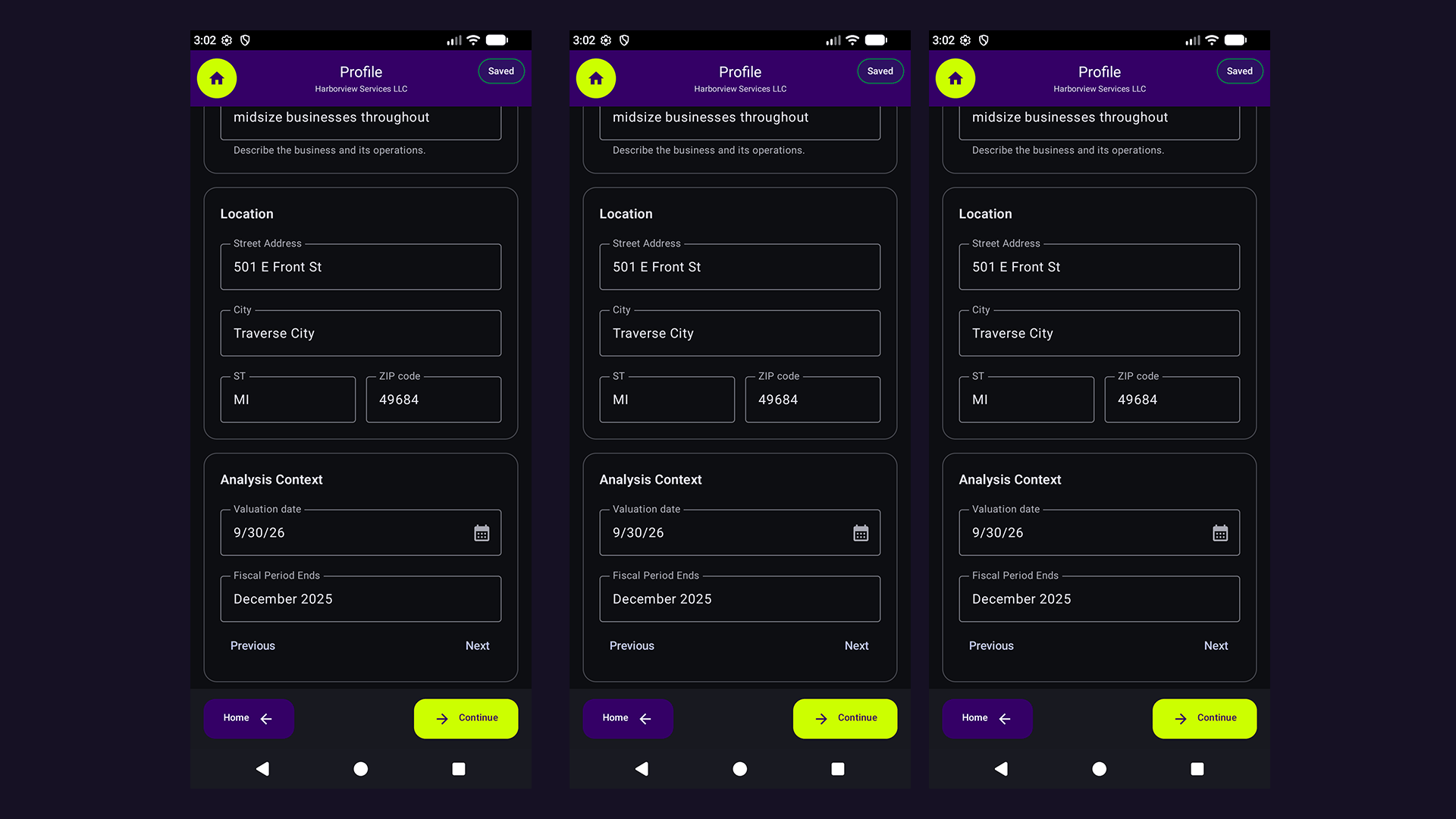
Rather than beginning with a desired selling price, the analysis starts with the business itself.
2. Understanding the Financial Performance
The next step is to examine the company's reported financial results.
For the fiscal year ending December 31, 2025, Harborview reports:
Financial measure | Amount |
|---|---|
Gross revenue | $850,000 |
Gross profit | $680,000 |
Total expenses | $585,000 |
Net income | $95,000 |
Revenue provides important context, but it is not the same as business value.
A company generating substantial revenue may have relatively modest earnings after operating expenses. Another business with lower revenue may generate stronger earnings and ultimately command a higher valuation.
BusinessLens organizes the financial information so the user can understand the relationship between revenue, expenses, and profitability.
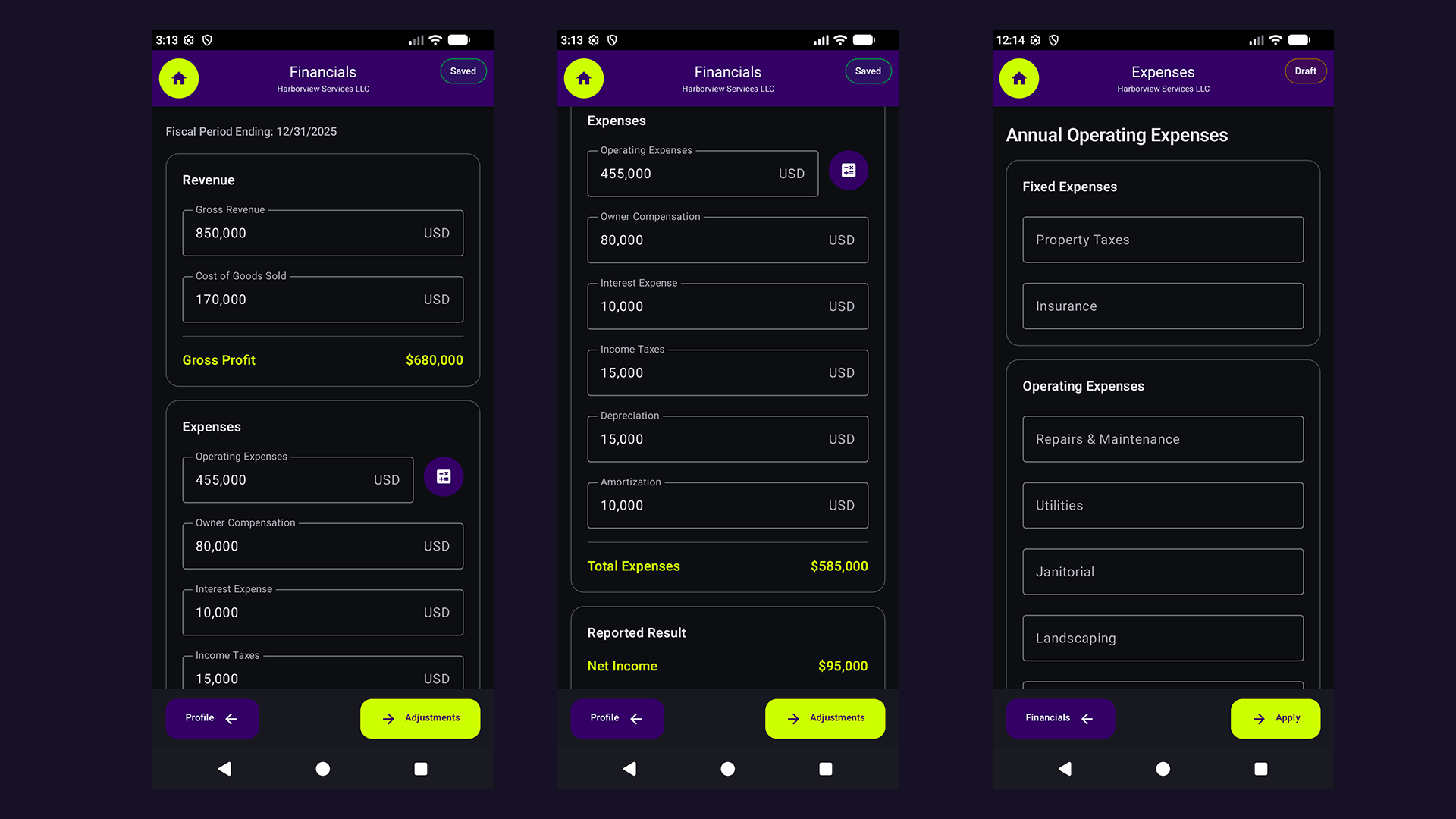
Reported financial performance provides the starting point for the valuation.
These figures establish a baseline, but they do not necessarily reflect the earnings a prospective buyer might expect from normal operations.
That requires another step.
3. Normalizing Business Earnings
Business owners sometimes incur expenses that are unusual, discretionary, or not expected to continue after a sale.
Examples might include one-time professional fees, certain owner-related expenses, or other costs that can be reasonably documented and adjusted.
These items require careful consideration. Not every expense qualifies for an adjustment, and unsupported add-backs can distort the valuation.
In our example, Harborview incurred a one-time $5,000 legal expense related to an unusual contract restructuring project.
Because the expense was included in the reported financial results and is assumed not to recur under normal operations, it is considered as a potential normalization adjustment.
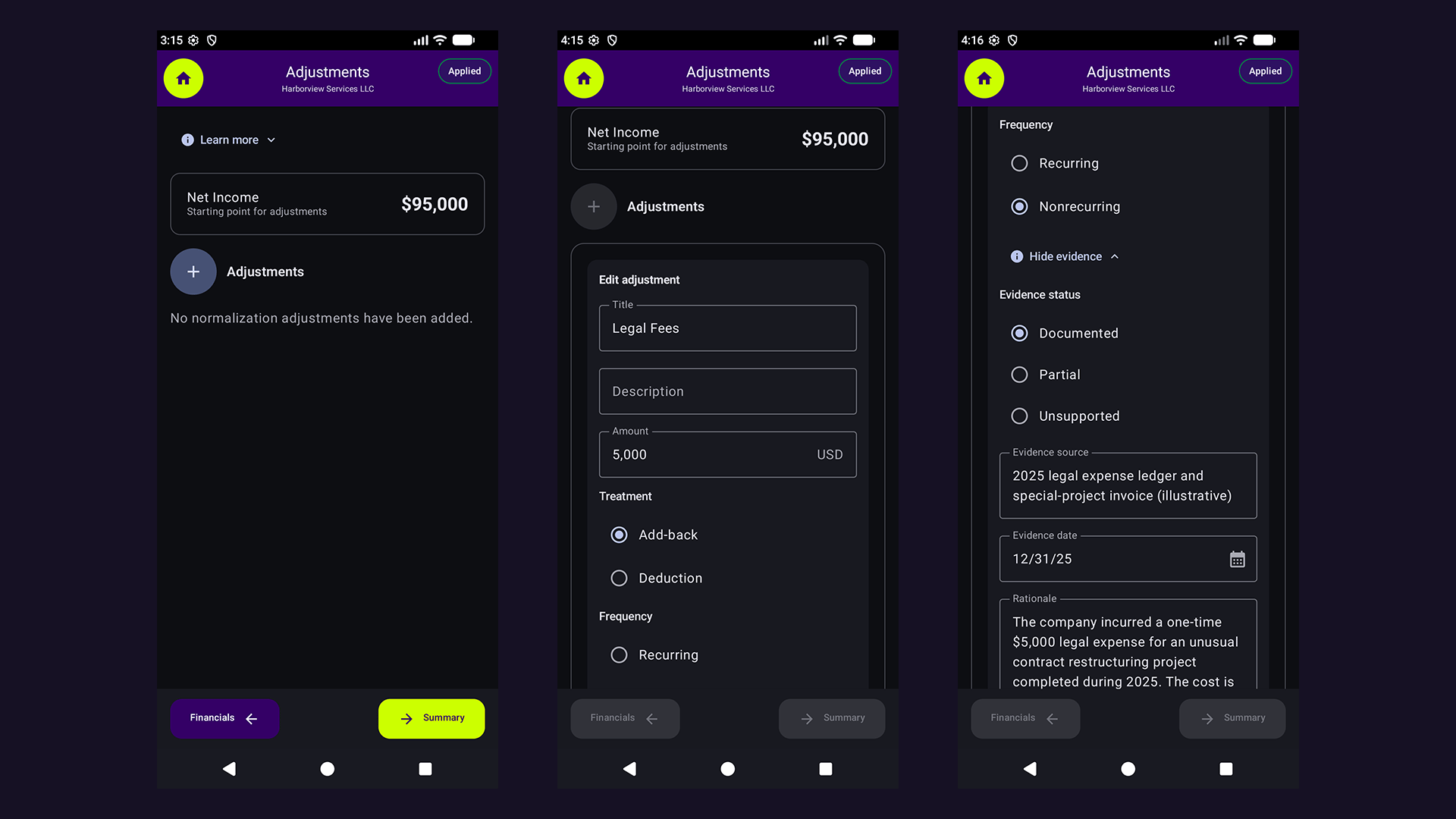
BusinessLens allows normalization adjustments to be identified and supported with evidence.
The adjustment includes an explanation, source information, and documentation status. This creates a record of why the adjustment was made rather than simply increasing earnings without justification.
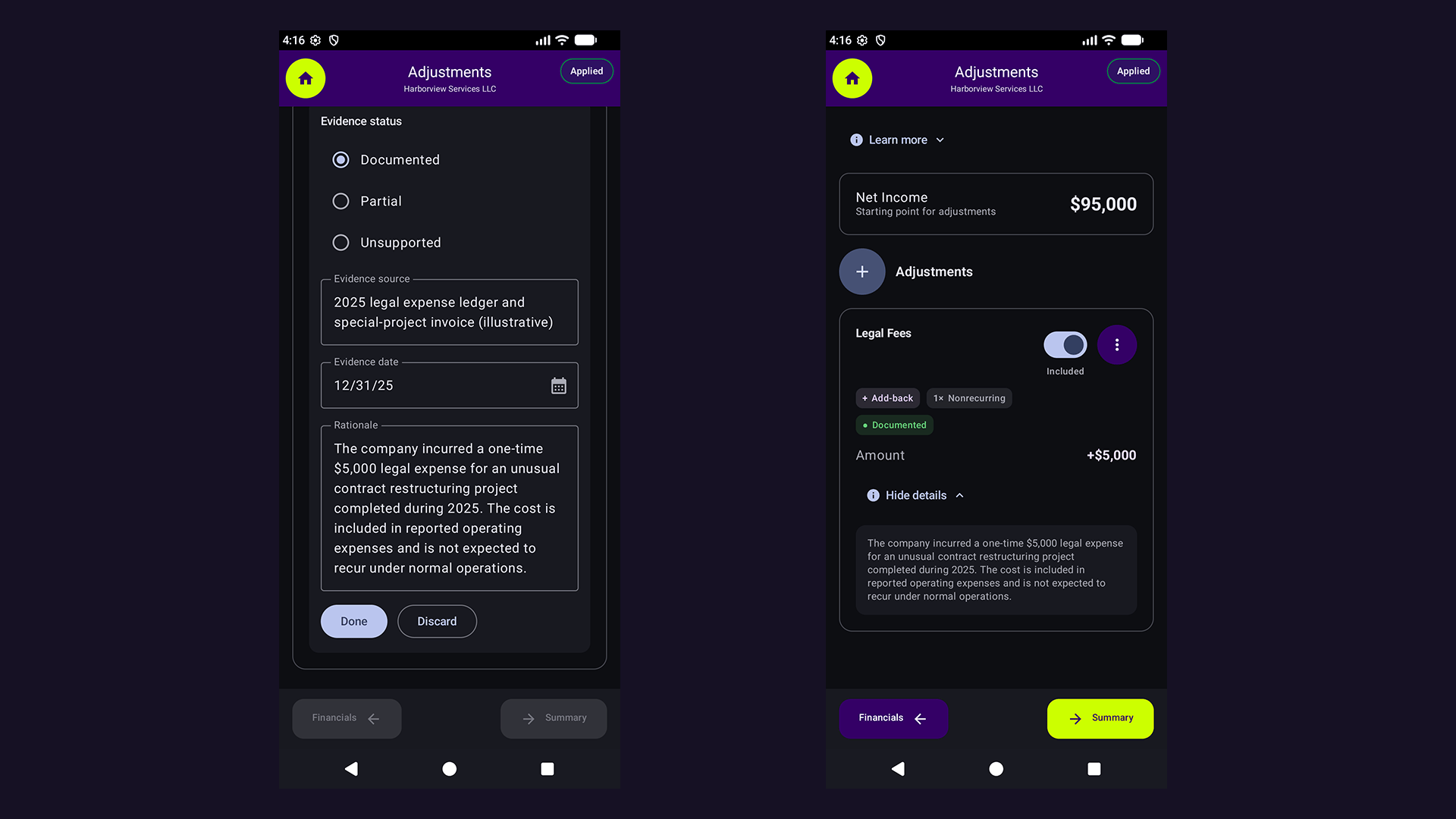
Supporting information helps distinguish documented adjustments from unsupported assumptions.
After the relevant normalization calculations, Harborview's illustrative earnings measures are:
Earnings measure | Amount |
|---|---|
Normalized EBITDA | $150,000 |
Normalized SDE | $230,000 |
EBITDA, or earnings before interest, taxes, depreciation, and amortization, is commonly used when evaluating businesses with a management structure that can operate independently of the owner.
Seller's Discretionary Earnings (SDE) is often useful for smaller, owner-operated businesses because it considers the economic benefit available to a working owner under the selected normalization assumptions.
These are different valuation measures, and the appropriate one depends on the nature of the business and the intended buyer.
4. Assessing the Business Beyond Its Financial Statements
Two businesses with identical earnings may have different values.
One might depend heavily on its owner, have concentrated revenue from a few customers, or require significant future investment.
Another might have recurring revenue, transferable operating rights, strong financial records, and an established management team.
BusinessLens includes a structured assessment of characteristics that may influence valuation assumptions.
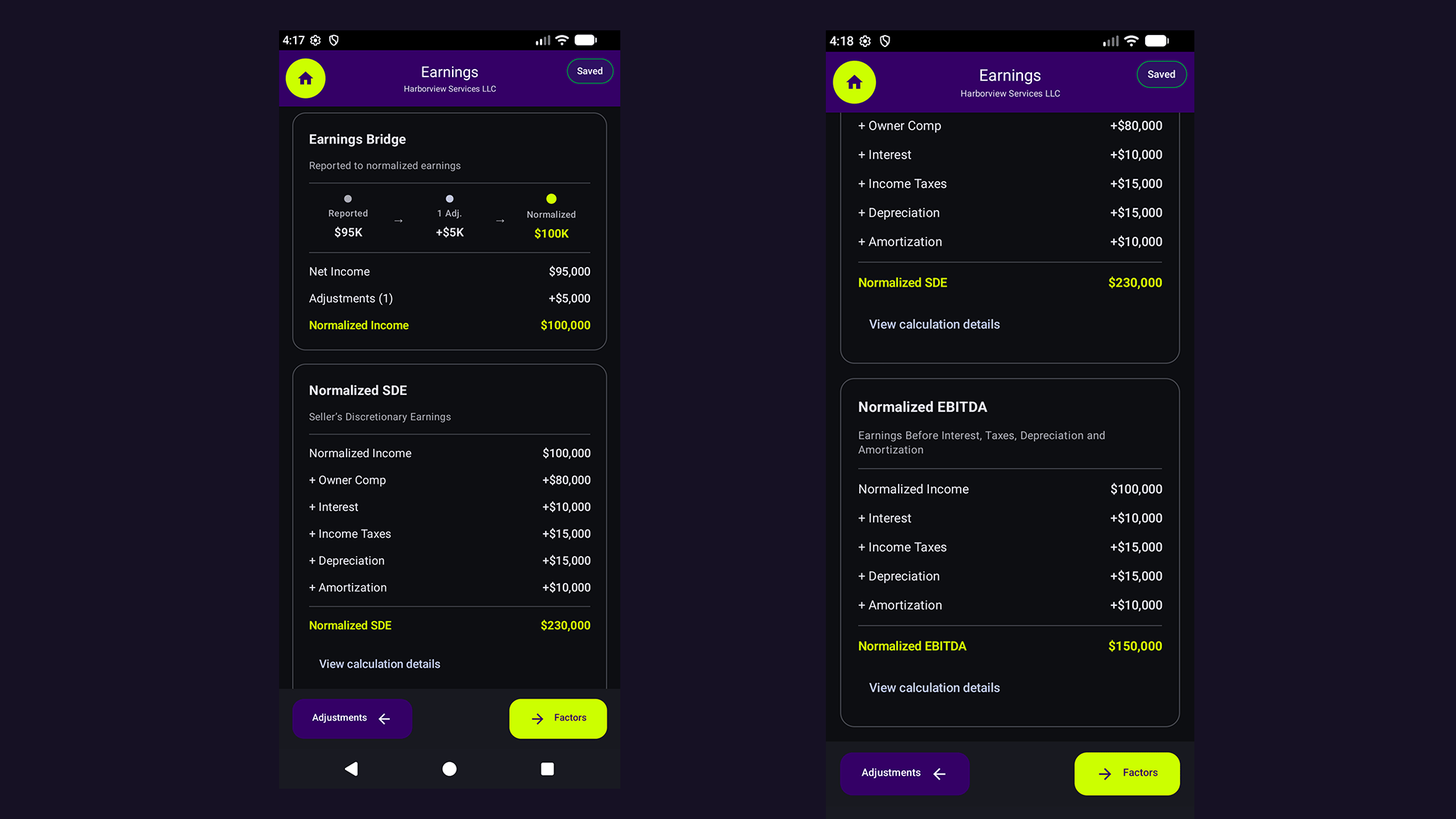
Business-specific characteristics provide context for interpreting financial performance.
For Harborview, the illustrative assessment includes stable earnings, predictable revenue, moderate owner dependence, transferable operating rights, and strong financial-record quality.
The assessment identifies four supportive characteristics, four neutral characteristics, and no characteristics classified as risks.
That does not mean the business is risk-free. It means the selected factors in this example are generally neutral or supportive of the valuation assumptions.
5. Selecting a Valuation Method and Multiples
Once earnings have been normalized and the business characteristics considered, BusinessLens moves to valuation multiples.
For Harborview, we select the SDE method because the fictional company is being evaluated as an owner-operated business.
The normalized SDE is $230,000.
The illustrative multiple range is:
Multiple | Selected value |
|---|---|
Low | 2.9× |
Expected | 3.6× |
High | 4.6× |
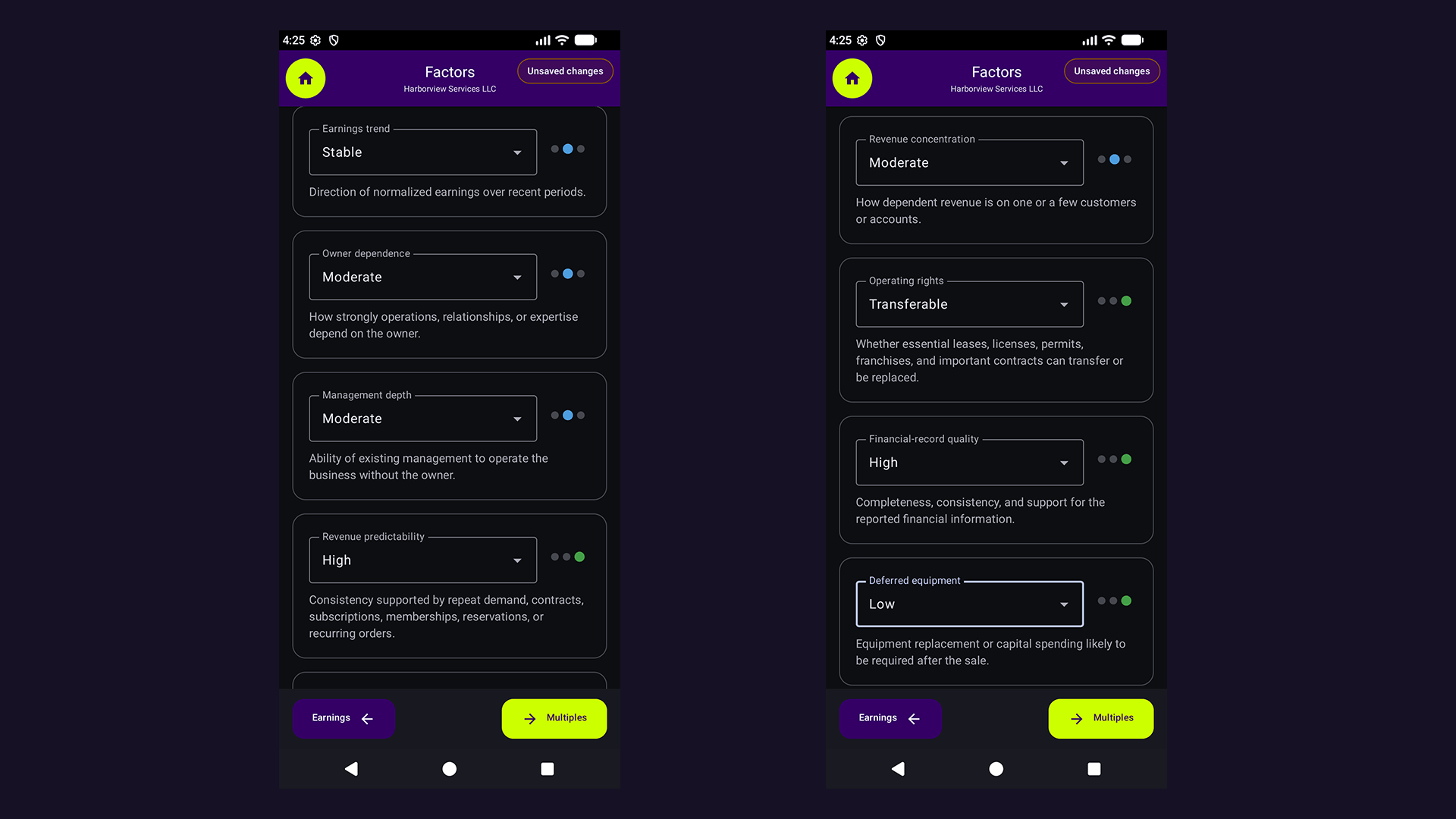
The selected valuation method and multiple range establish the basis for calculating business value.
BusinessLens offers suggested starting ranges and a professional option for entering supported multiples.
Suggested ranges are analytical starting points, not verified transaction comparables or substitutes for current market research. A professional valuation should consider relevant industry evidence, transaction data, and the circumstances of the specific business.
6. Calculating the Business Value Range
Applying the selected multiples to Harborview's normalized SDE produces the following indicated values:
Valuation | Calculation | Indicated value |
|---|---|---|
Low | $230,000 × 2.9 | $667,000 |
Expected | $230,000 × 3.6 | $828,000 |
High | $230,000 × 4.6 | $1,058,000 |
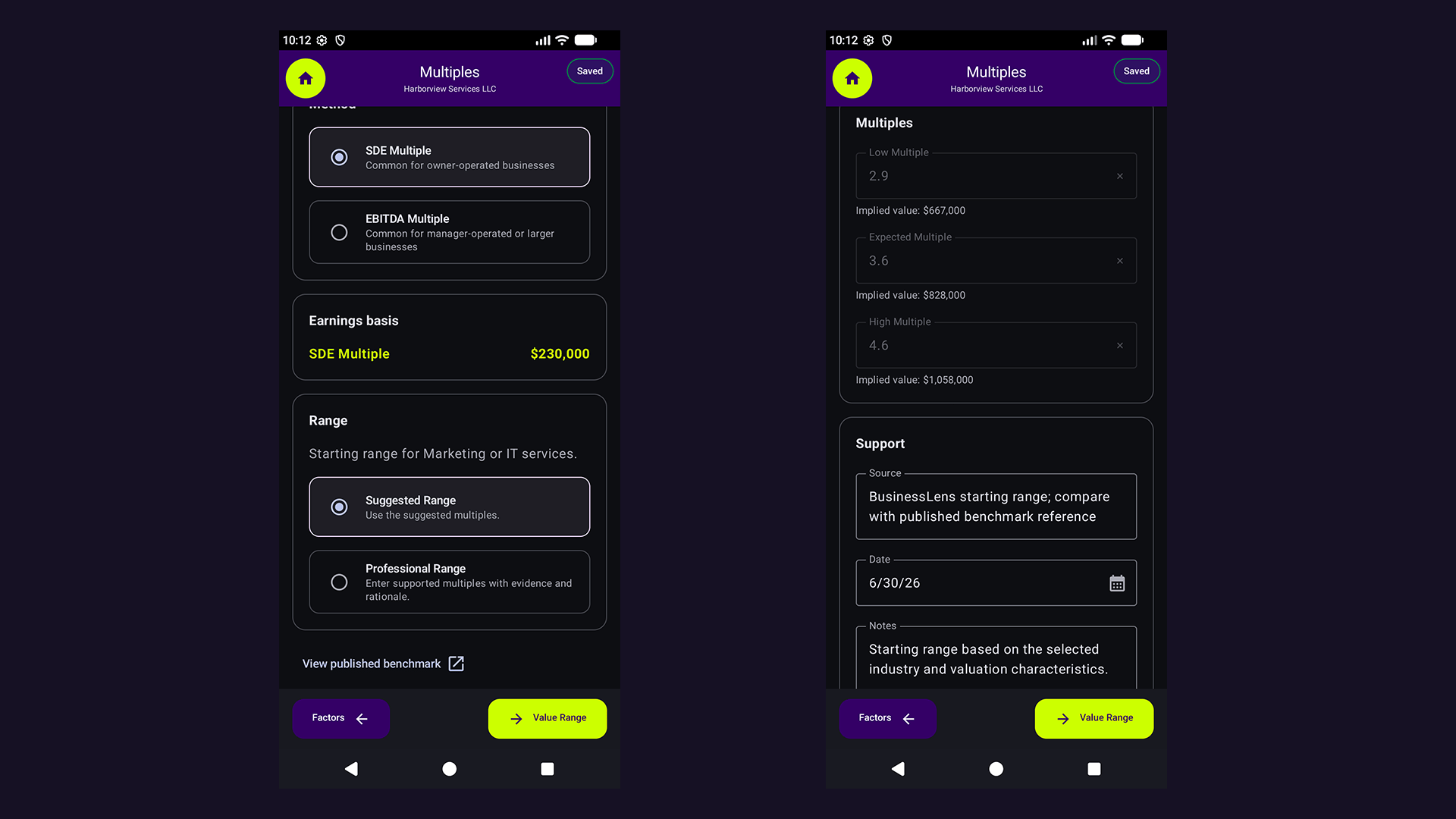
BusinessLens calculates a low, expected, and high value using the selected earnings basis and multiples.
This produces a business-only valuation range before considering any separately valued assets or liabilities.
The range is more informative than a single number because it reflects the uncertainty inherent in business valuation.
7. Accounting for Additional Business Assets
For an IT services business, certain intangible assets can be important.
Examples include domain names, proprietary software, intellectual property, or transferable digital assets.
However, there is a critical distinction: an asset should not be added separately if its economic value is already reflected in the earnings-based valuation.
In this case study, Harborview owns a fictional premium domain name, HarborviewIT.com.
For demonstration purposes, we assume the domain has an independently realizable market value of $12,000 beyond the operating-business value.
BusinessLens records this as a separately identified value component with an explanation of the supporting assumptions.
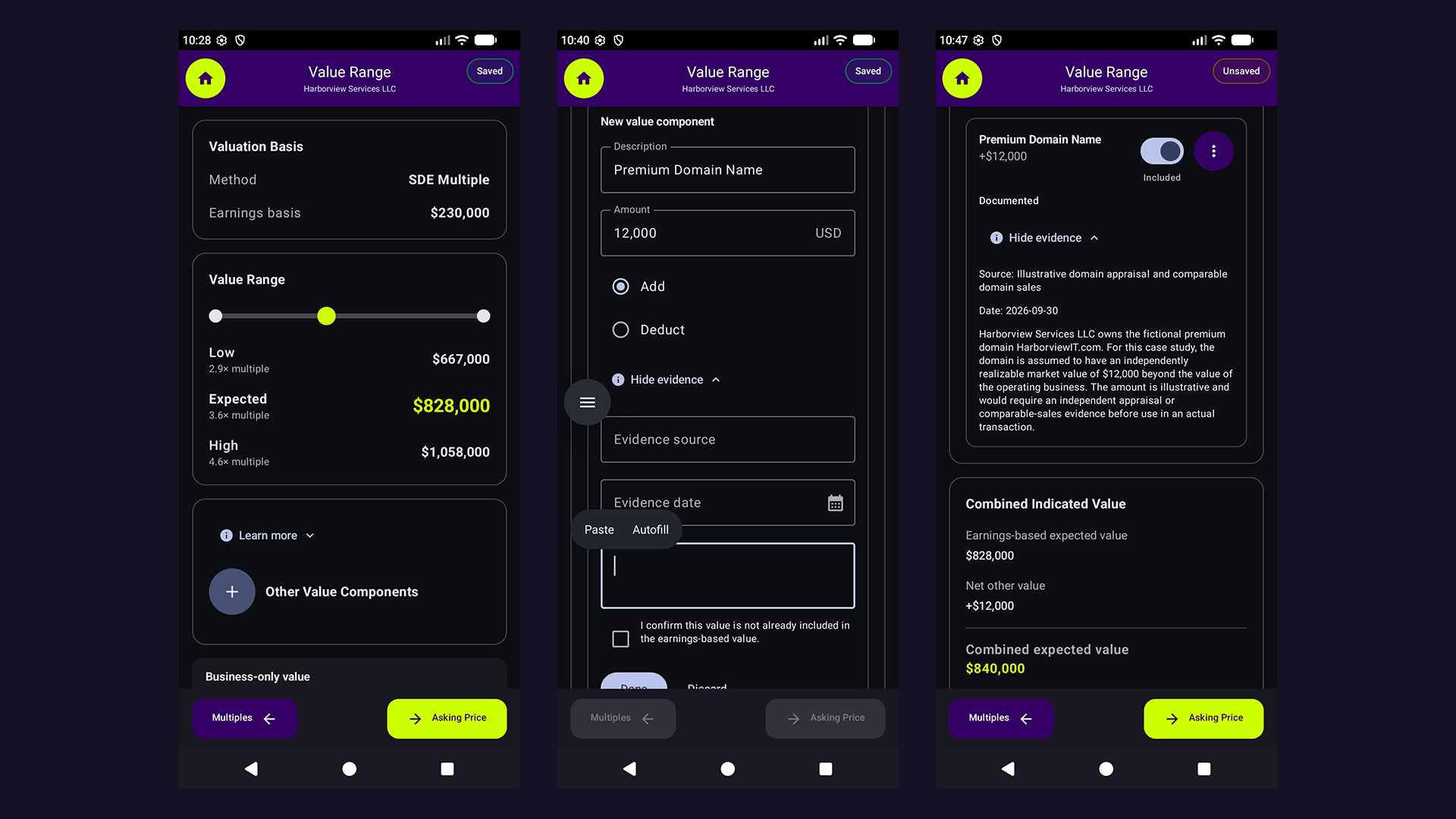
The additional value component identifies a premium domain name and documents why it is being considered separately.
The resulting reconciliation is:
Value component | Amount |
|---|---|
Business-only expected value | $828,000 |
Premium domain name | +$12,000 |
Combined expected value | $840,000 |
The adjusted range becomes $679,000 to $1,070,000.
The domain valuation is illustrative and would require independent support before use in an actual transaction.
8. Evaluating the Seller's Asking Price
A business valuation and an asking price are related, but they are not necessarily identical.
An owner may choose an asking price above the expected value to provide negotiating room, reflect specific transaction considerations, or test market interest.
For Harborview, we enter a proposed asking price of $925,000.
BusinessLens compares that figure against the indicated valuation range.
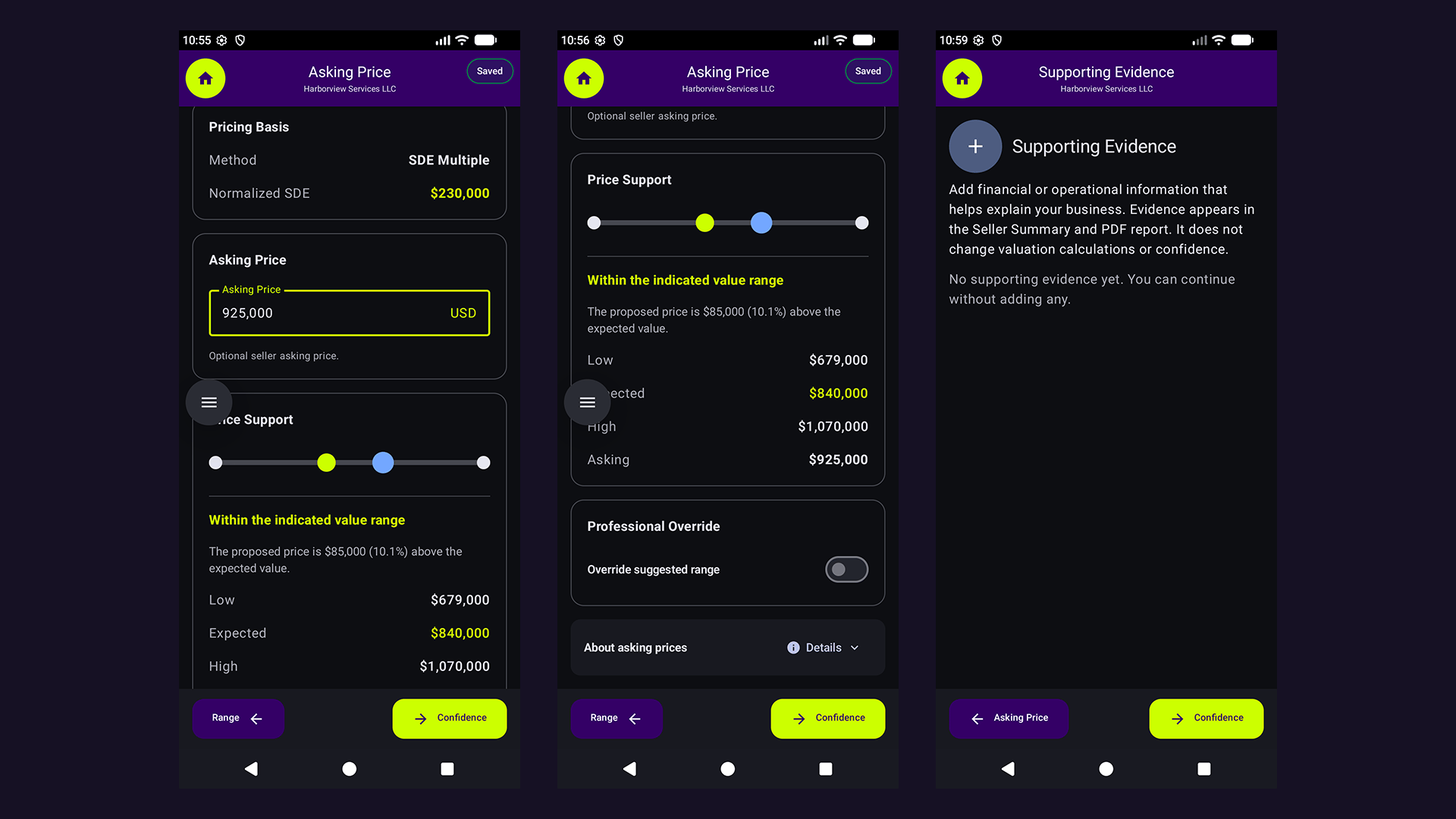
The asking-price comparison shows how the proposed price relates to the indicated value range.
The results are straightforward:
- Expected value: $840,000
- Proposed asking price: $925,000
- Difference: $85,000
- Premium above expected value: approximately 10.1%
The asking price is above the expected value but remains within the indicated range of $679,000 to $1,070,000.
That makes the proposed price potentially defensible, provided the supporting assumptions hold up under review.
Being within a valuation range does not, by itself, establish that a buyer will pay the asking price.
9. Reviewing Confidence and Reaching a Professional Conclusion
Valuation calculations are only as reliable as the information and assumptions supporting them.
BusinessLens includes an evidence review that distinguishes documented items from those with partial or insufficient support.
For Harborview, the case study includes documented support for the normalization adjustment and the separately identified domain value, within the illustrative assumptions of the example.
The analysis displays a high confidence assessment for the evidence items reviewed.
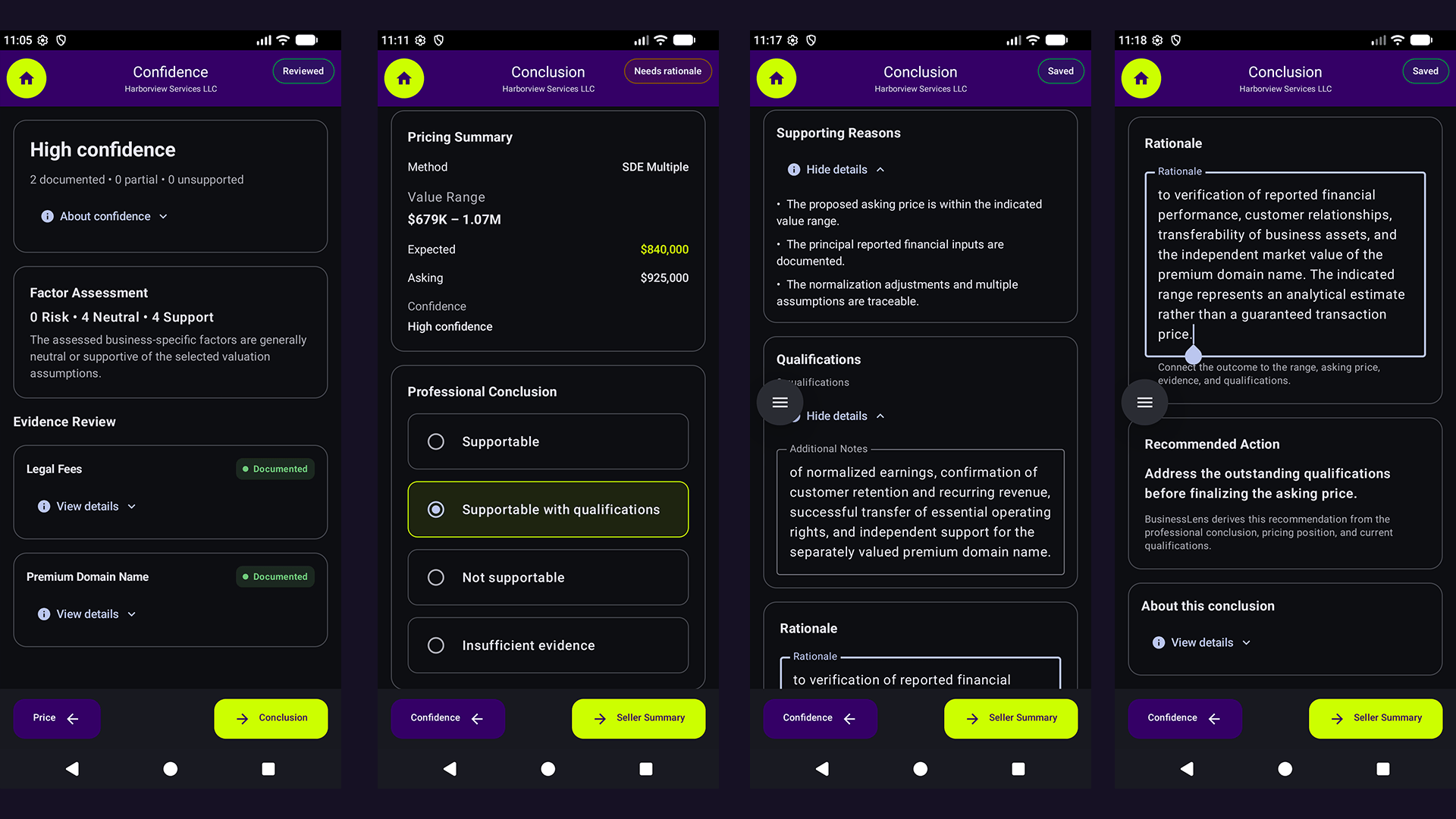
Evidence review and professional judgment help determine how the valuation should be interpreted.
The selected professional conclusion is:
Supportable with qualifications.
This means the asking price can be reasonably considered within the illustrated valuation framework, but important assumptions should be verified before relying on the conclusion in a real transaction.
Those qualifications include verification of normalized earnings, customer retention and recurring revenue, transferability of operating rights, and independent support for the premium domain's value.
10. Bringing the Analysis Together
The final BusinessLens Seller Summary consolidates the valuation into a readable presentation.
It brings together the business profile, financial results, normalization adjustments, valuation factors, selected multiples, and calculated value range.
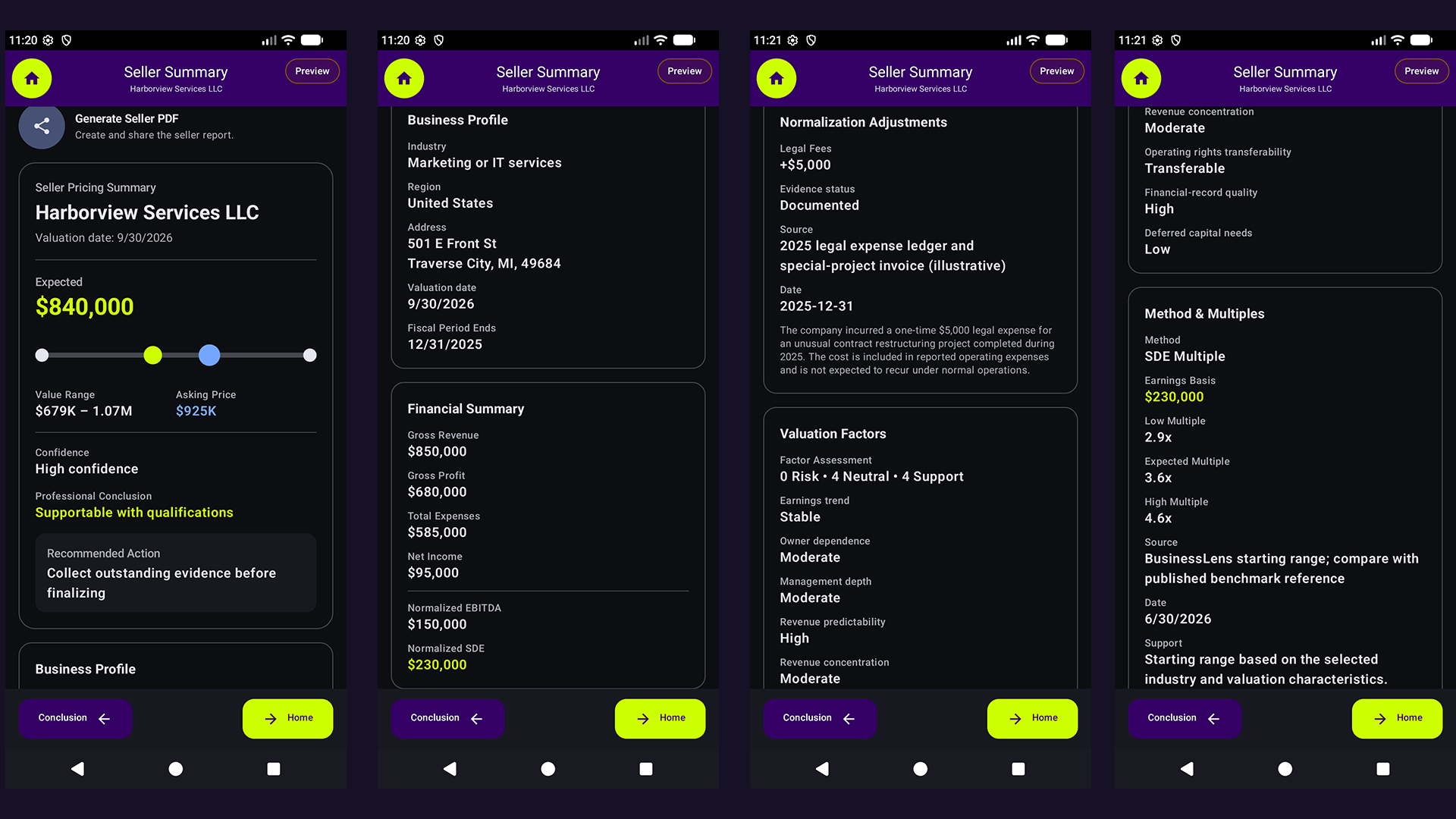
The Seller Summary connects the financial analysis with the valuation methodology and pricing conclusion.
For Harborview Services LLC, the illustrative results are:
Final result | Amount or conclusion |
|---|---|
Normalized SDE | $230,000 |
Expected multiple | 3.6× |
Business-only expected value | $828,000 |
Separately identified domain value | $12,000 |
Combined expected value | $840,000 |
Adjusted value range | $679,000–$1,070,000 |
Proposed asking price | $925,000 |
Professional conclusion | Supportable with qualifications |
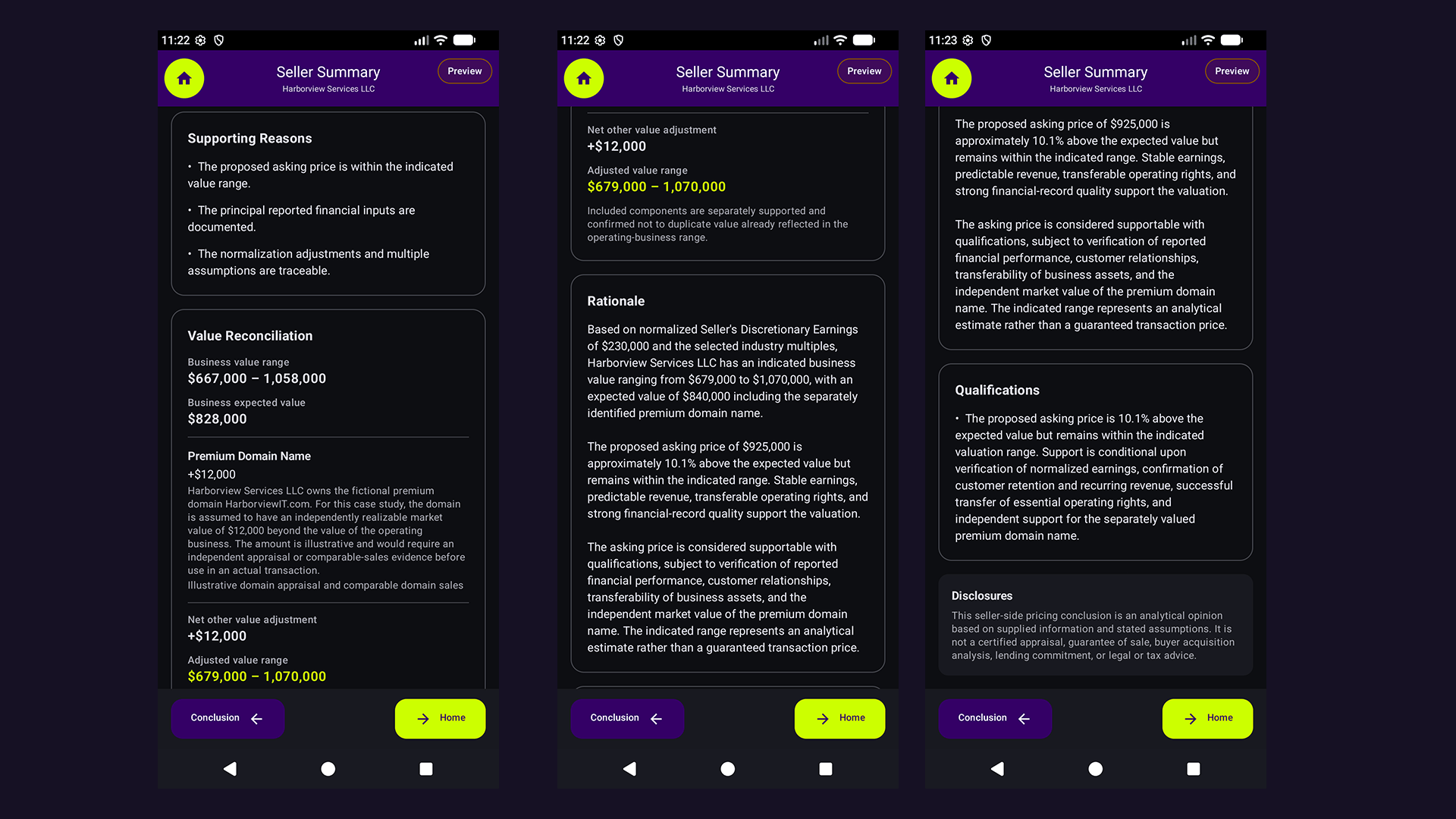
The completed summary explains the valuation rationale, qualifications, and limitations.
BusinessLens can also generate a seller PDF report for sharing or professional review. The report provides a way to communicate the analysis beyond the application itself.
What This Case Study Demonstrates
Harborview Services LLC is fictional, but the analytical process reflects the decisions business owners and advisors face when considering a sale.
The value of a structured workflow is not simply that it produces a number.
It helps users understand where that number came from.
BusinessLens brings together financial analysis, normalized earnings, valuation assumptions, supporting evidence, and seller pricing in one application.
For business owners, this can provide a clearer starting point for discussions about a potential sale.
For brokers and advisors, it offers an organized way to develop and communicate a seller-side pricing analysis.
And for anyone exploring the value of a business, it reinforces an important principle:
A credible asking price begins with an understandable, supportable valuation.
Explore Cygnus BusinessLens
Cygnus BusinessLens is part of the Cygnus Android App Suite, a collection of professional tools for real estate investment, business valuation, and property management.
BusinessLens is available for Android through Google Play with a one-time purchase model. No subscriptions or advertising.
Explore BusinessLens and the complete Cygnus App Suite:
https://cygnusrealestate.com/android-apps
Disclaimer: Harborview Services LLC, its financial results, asset values, and valuation conclusions are fictional and presented solely to demonstrate the application's workflow. BusinessLens provides analytical tools and does not replace a qualified business valuation, appraisal, legal review, tax advice, or transaction due diligence.